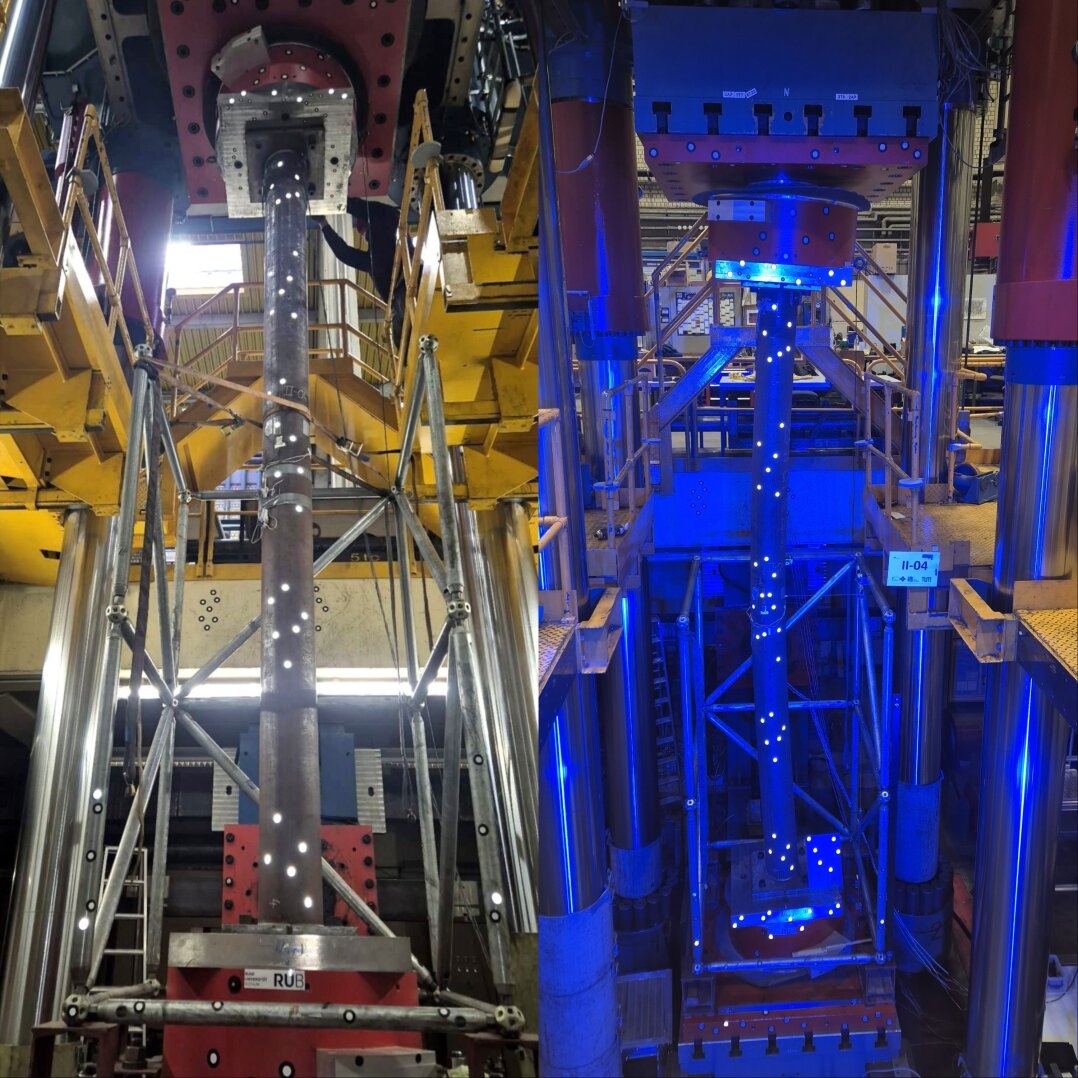
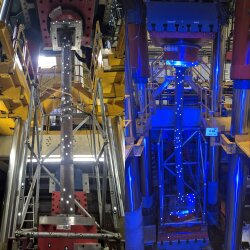
Composite columns offer a slim and load-bearing alternative to solid concrete columns in high-rise and industrial buildings. Research shows that high-strength steel increases the load-bearing capacity of these columns and contributes to more efficient structures. In the HOCHFEST cluster of FOSTA e.V., various designs of hollow section composite columns were developed and their load-bearing mechanisms investigated.
However, there is currently no basis for a uniform design concept for the hollow section composite columns investigated. This joint research project is being carried out in order to consolidate the scientific findings and answer questions that are still open for practical engineering applications. A major advantage of the collaboration is the scientific consensus of renowned research centers on a common problem.
Previous design approaches according to EN 1994-1-1 have proven to be insufficient for the mathematical design of new structural forms using high-strength steels. The use of high-performance materials brings with it new phenomena that must be taken into account when calculating load-bearing capacities. Therefore, the influences of these steels are to be quantified through experimental testing and probabilistic parameters derived in order to enable reliable design. In addition, there is currently little or no knowledge regarding the clamping effects of composite columns in ceiling systems. Taking these into account could reduce buckling lengths and thus slenderness ratios, thereby allowing the load-bearing capacity reserves of the steel used to be exploited efficiently.
The aim of the research project is to develop a uniform design approach for novel concrete-filled hollow section composite columns with high-strength steel at room temperature and a simplified verification method (Level 2) under fire exposure. The influencing parameters are determined in a standardized manner and verified probabilistically.
The desired results will enable the special requirements of newly developed high-strength composite columns to be taken into account and consistent dimensioning to be achieved. This will remove obstacles for planners, clients, and contractors and create opportunities for the use of high-performance composite columns. The slim construction methods and efficient cross-sectional utilization provide a sustainable and economical alternative to previous support systems.
Ruhr University Bochum
Chair of Steel, Lightweight, and Composite Structures
Associate Professor Rebekka Winkler, Przemyslaw Schurgacz, M.Sc.
University of Stuttgart
Institute of Structural Design
Prof. Markus Knobloch, Elisa Grimaldi M.Sc.
RWTH Aachen University
Chair of Steel and Light Metal Structures
Prof. Markus Feldmann, Jonas Nonn M.Sc.
Technical University of Munich
Prof. Martin Mensinger, Constantin Schwendner M.Sc.
Chair of Metal Structures
FOSTA No. P1778, IGF Nr. 23408
01.10.2024
Copyright © Stahlbau 2026
Last update: Jan 23, 2026